Build a Myrtle Beach Story Wall in Three Prints
By Deacon Dawson Art ·
A well-chosen group of Grand Strand prints can do more than fill a wall. Start with three Myrtle Beach landmarks and let the places, eras, and memories speak to one another.
A single landmark print can bring back a clear picture: a familiar sign, a long-ago night out, a first trip to the beach, or a place someone always points out while driving down the Strand. But three prints hung together can do something larger. They create a conversation between places.
That is the appeal of building a small themed collection. Instead of asking one picture to carry every memory, you can choose a few pieces that show different sides of Myrtle Beach: the excitement, the arrival, and the everyday places that helped make the town feel like itself. A trio also gives a wall a little rhythm. Each print stands on its own, while the group tells a broader story.
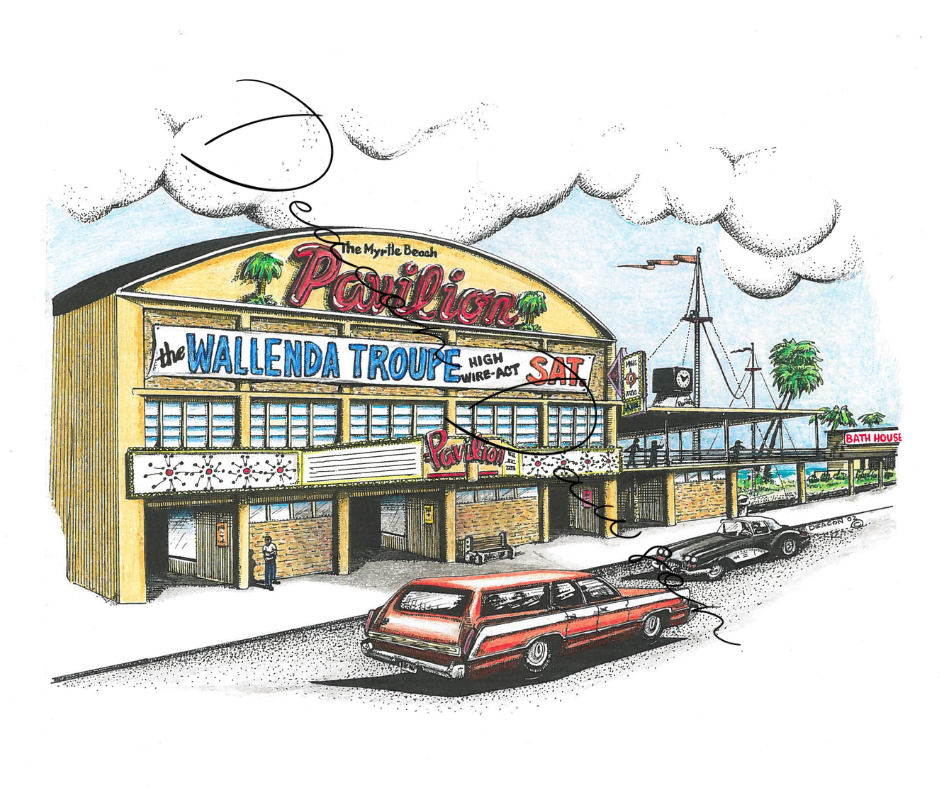
For a Myrtle Beach-focused set, begin with the Myrtle Beach Pavilion Version 2 Print, add the Myrtle Beach Train Depot, and finish with Studebaker's Print. Together, they make a thoughtful collection for a den, hallway, office, beach place, or any room where Grand Strand memories belong.
Start with the place everyone recognizes
The Myrtle Beach Pavilion Version 2 Print is a natural anchor for this group. For many people, the Pavilion is inseparable from memories of Myrtle Beach itself. It suggests bright lights, movement, summer evenings, family trips, and the particular energy of the oceanfront. Even for someone who did not grow up here, it can represent the Myrtle Beach they came to know.
As the first piece in a set, the Pavilion gives the eye an immediate place to land. It is the print that says, plainly and happily, “Myrtle Beach.” From there, the other works can widen the story. A collection does not have to be a row of identical subjects. In fact, it is often more interesting when each print covers a different kind of local landmark.
That is one reason pen-and-ink works so well in a grouping. The shared drawing style connects the scenes, even when the buildings and memories are very different. The lines, detail, and hand-signed character give the prints a common visual language without making the wall feel overly matched.
Add the route that brought people here
The Myrtle Beach Train Depot adds a quieter but important chapter. Constructed in 1937, Myrtle Beach’s first passenger and freight station was built by Myrtle Beach Farms Company and turned over to Atlantic Coast Line Railroad Co. on May 6 of that year. The depot served an early Grand Strand need: bringing in goods and supplies, as well as tourists.
That history makes the depot an especially good companion to the Pavilion. One print evokes the destination; the other suggests the journey and the growth of a beach town connected to the wider world. By the early 1960s, better roads and air transportation had affected the depot’s role, but its image still carries the feeling of an earlier Myrtle Beach.
On a wall, this pairing has a useful contrast. The Pavilion has the lively pull of the oceanfront. The depot brings architecture, transportation, and a sense of how people and provisions once reached the area. The two pieces do not repeat each other. They give the collection depth.
For a simple arrangement, place the Pavilion and depot side by side. Let whichever image means the most to you take the left or center position. There is no required order; the best layout is the one that feels right in your room. If you are hanging them in a narrow hallway, a vertical sequence can read almost like a walk through local history.
Finish with a place that feels personal
Every good collection needs a print that shifts the story from the big landmark to the remembered stop: a place tied to a meal, a job, a date, a family tradition, or a night that still comes up in conversation. Studebaker's Print can be that third piece.
Its value in the trio is not that it has to mean the same thing to everybody. Quite the opposite. It gives the collection room for individual memory. Someone may see the Pavilion and think of childhood vacations, the depot and think of the way Myrtle Beach changed, and Studebaker’s and think, “I remember that place.” Those different reactions are what turn a group of prints into a story wall rather than a set of decorations.
Try placing Studebaker’s between the two larger ideas of arrival and amusement. The result is a more human picture of the Grand Strand: not just the destination people came to see, but the places where life happened once they got there. If you prefer a looser, collected look, hang the three prints with a little breathing room instead of forcing them into a rigid grid. A shared frame color can tie them together, while different frame profiles can make the display feel gathered over time.
Why three prints often say more than one
Three is an easy number to live with. It is enough to make a statement, but not so many that you need an entire gallery wall. It works above a sofa, along a stairway, over a desk, or across a dining-room wall. It also leaves room to grow later if another Grand Strand place calls to you.
More importantly, a three-print collection lets you show the range of a place you love. The Pavilion, the depot, and Studebaker’s are not one-note reminders. They suggest recreation, connection, and the local spots that become part of a person’s own map of Myrtle Beach.
Deacon Dawson’s work comes from a real connection to this coast. He has called South Carolina’s Grand Strand home since arriving in Myrtle Beach in 1968, and his pen-and-ink pictures focus on landmark structures, past and present. Each hand-signed print offers a detailed reminder of the places that remain part of the area’s shared story.
A wall does not need to explain every memory. It only needs to give people a reason to start talking about them. Choose the three scenes that feel like your Myrtle Beach, then let the stories follow.
Shop the Myrtle Beach Pavilion Version 2 Print, Myrtle Beach Train Depot, and Studebaker's Print to start your own Grand Strand collection.