How Pen-and-Ink Keeps Grand Strand Landmarks Close
By Deacon Dawson Art ·
See how Deacon Dawson’s hand-signed pen-and-ink prints preserve the lines, signs, and stories of Brant’s, Chesapeake House, and the Chesterfield Hotel.
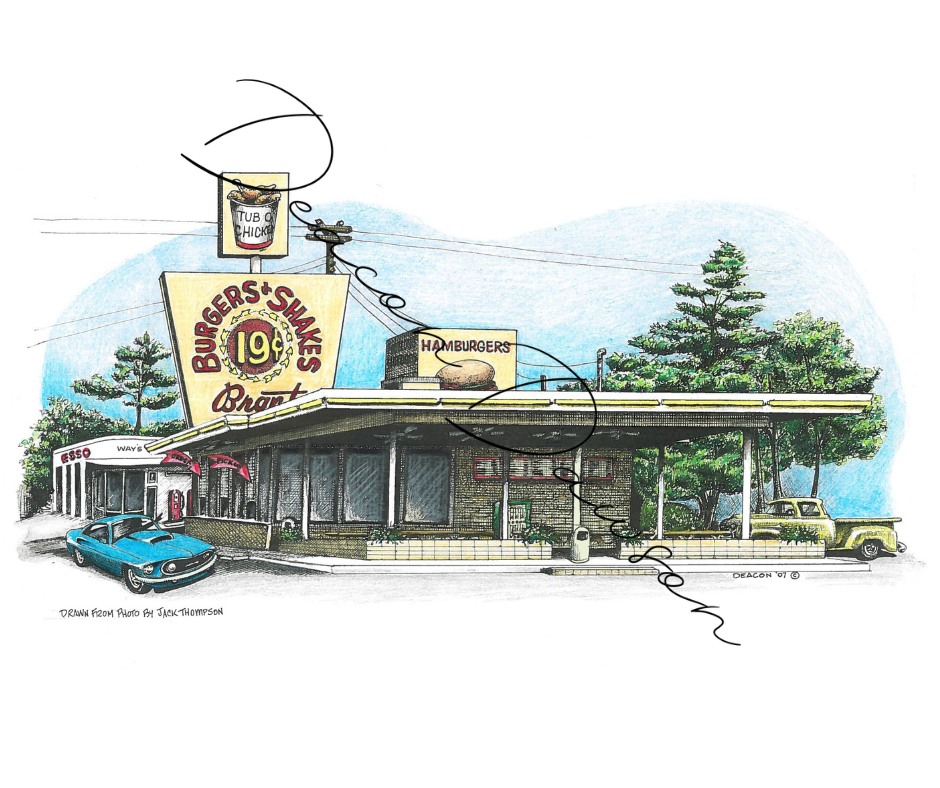
A Deacon Dawson hand-signed pen-and-ink print keeps a Grand Strand landmark present through the details people remember: the building’s shape, its sign, its setting, and its character. Brant’s, Chesapeake House, and the Chesterfield Hotel each offer a different kind of Myrtle Beach-area memory, made lasting in drawn line.
Why do hand-drawn landmark prints feel so personal?
A photograph catches one moment. A pen-and-ink drawing asks the eye to slow down and follow the structure: the roofline, windows, brickwork, lettering, shadows, and the small visual decisions that give a familiar place its identity. Those details are why a drawing of a restaurant, hotel, or roadside stop can bring back a whole afternoon.
For people who grew up here, visited every summer, worked nearby, or simply love the changing face of the coast, landmarks are more than addresses. They hold routines. They suggest a first vacation, a favorite meal, a walk toward the ocean, or the route someone took through town for years. A black-and-white pen-and-ink image leaves room for the viewer’s own color and story.
That is central to Deacon Dawson’s work. Proud to call South Carolina’s Grand Strand home, Deacon arrived in Myrtle Beach from Huntington, West Virginia, in 1968. His pictures focus on landmark structures, past and present, and his connection to the area gives the drawings the feeling of an observation made by someone who knows that buildings can become part of local life.
A hand-signed pen-and-ink print also makes the artwork feel direct. The drawing is a reminder of a specific place, while Deacon Dawson’s signature connects it to the artist who put that place into line and ink.
What should you notice in the Brant’s Print?
The Brant’s Print looks back to a Myrtle Beach gathering place at the corner of 3rd Avenue South and Kings Highway 17. From the 1960s into the mid-1990s, John Branton and his family welcomed locals and tourists to Brant’s, known for burgers, shakes, hot dogs, fried chicken, ice cream, and a straightforward meet-and-eat spirit.
When looking at a pen-and-ink drawing of a place like Brant’s, start with the overall silhouette. A restaurant building may seem ordinary until you remember how quickly you recognized it from the road. The drawn exterior brings attention to the sign, the entrance, the proportions of the building, and the practical, familiar presence that made Brant’s part of a day at the beach.
Brant’s also carries the kind of story that makes a landmark print more than decoration. After Mr. Branton sold Brant’s, the building was moved across 3rd Avenue South, facing the Swamp Fox Roller Coaster at Family Kingdom. The original location is now occupied by Wings. That change makes the image especially meaningful: it preserves a visual reference point for people who remember the earlier corner and the meals that went with it.
How does the Chesterfield Hotel print preserve old Myrtle Beach?
The Chesterfield Hotel Print represents a historic Myrtle Beach hotel that stood at 7th Avenue North and Ocean Boulevard, one block south of the former Myrtle Beach Pavilion. The brick building dated from 1946, replacing an earlier five-room house built in 1936 that burned. The hotel remained part of the oceanfront landscape until 2012.
This is the kind of subject that shows the strength of pen and ink. Architecture has its own language: repeated windows, solid walls, trim, entrances, and the balance between a building and the street around it. Fine line work helps viewers read those features without distraction, making the Chesterfield Hotel’s form the focus.
The Chesterfield Hotel also had a long human history. Clay Brittain worked there as a teenager, later became an owner in 1965, and ran the hotel until 1991. The hotel was listed on the National Register of Historic Places in 1996. Knowing those facts changes how a viewer sees the drawing: not as a generic old hotel, but as a particular Myrtle Beach building connected to people and decades of oceanfront change.
For a home office, hallway, or living room, the Chesterfield Hotel print can prompt the kind of conversation that starts with, “Do you remember when that was there?” It is a thoughtful choice for anyone drawn to Myrtle Beach history, classic oceanfront architecture, or the places that disappear while their stories remain.
What makes the Chesapeake House Print a Grand Strand keepsake?
The Chesapeake House Print gives Grand Strand fans a restaurant landmark to recognize and revisit through Deacon Dawson’s pen-and-ink approach. Restaurant memories are often layered: the drive there, waiting for a table, a familiar view, the company at dinner, and the feeling of being on the coast even before the meal begins.
Look closely at how a drawn restaurant is assembled from lines. The strongest landmarks are often recognizable not because of one dramatic feature, but because several modest details work together: the building’s profile, the placement of the sign, the surrounding space, and the contrast between bright paper and dark ink. Pen and ink lets those visual clues carry the memory.
The Chesapeake House Print pairs naturally with other Grand Strand subjects because it speaks to the lived-in side of a beach trip. Not every meaningful coastal memory happens on the sand. Many happen around a table, on the road between neighborhoods, or at a place families return to whenever they are back in the area.
Deacon Dawson’s wider creative background includes album covers, posters, T-shirts, greeting cards, tattoo designs, and graffiti. Across those formats, a confident line matters. In his Grand Strand landmark art, that line becomes a way to honor buildings and businesses that have helped give the coast its visual character.
If Brant’s, Chesapeake House, or the Chesterfield Hotel belongs to your Grand Strand story, explore the Brant’s Print, Chesapeake House Print, and Chesterfield Hotel Print and choose the hand-signed pen-and-ink print that feels most like home.
Common questions
Are Deacon Dawson landmark prints hand-signed?
Yes. Every Deacon Dawson Grand Strand print is hand-signed by the artist. The signature adds a personal connection to artwork centered on South Carolina Grand Strand landmarks.
Which print is best for someone who remembers old Myrtle Beach?
The Chesterfield Hotel Print is a strong choice for someone who remembers historic oceanfront Myrtle Beach, while the Brant’s Print suits fans of classic local dining memories. The best choice is the landmark that brings a specific story to mind.
Why choose a pen-and-ink print of a restaurant or hotel?
Pen and ink brings attention to a landmark’s distinctive lines, signs, structure, and setting. A Deacon Dawson print can keep a meaningful Grand Strand place visible long after a visit—or after the place itself has changed.