Sonny’s Pavilion and the Sound of Ocean Drive
By Deacon Dawson Art ·
Remember Sonny’s Pavilion, where a gazebo became an Ocean Drive home for beach music and shag dancing. See how Deacon Dawson’s pen-and-ink print keeps that North Strand story close.
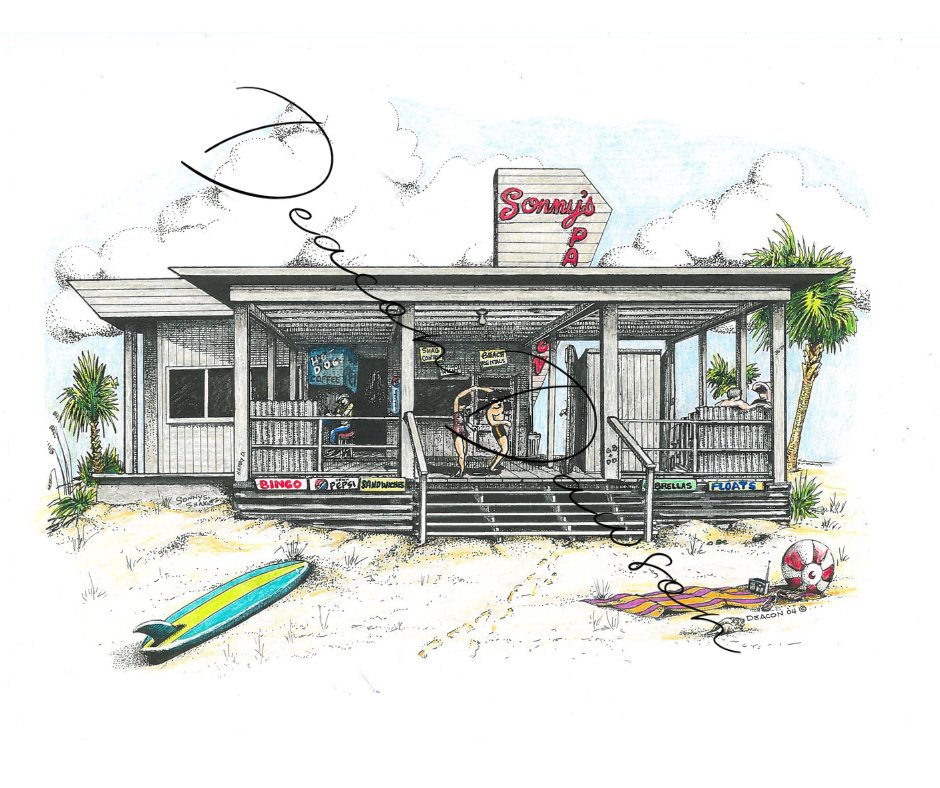
For shoppers seeking an Ocean Drive print with real Grand Strand character, Deacon Dawson’s Sonny’s Pavilion Print recalls the music, dancing, and late-night freedom that made Sonny’s a North Strand legend. This hand-signed pen-and-ink print honors a place shaggers still talk about and pairs naturally with Sloppy Joe’s and The Pad.
What made Sonny’s Pavilion an Ocean Drive landmark?
Sonny’s Pavilion began with a simple gazebo, moved and converted by Dr. N. F. “Sonny” Nixon into a gathering place built for beer, boogie, and beach music. A Wurlitzer jukebox, a dance floor, and no midnight curfew changed the feeling of the place. For people looking for a night out around Ocean Drive, that combination made Sonny’s Pavilion more than a building by the beach.
The landmark’s story also carries the weathered resilience that belongs to the Grand Strand. Hurricane Hazel brought the party to a stop on October 15, 1954, but Sonny’s Pavilion was rebuilt on the same spot the following spring. The version pictured in Deacon Dawson’s print represents Sonny’s as it stood from 1955 to 1989, while the original had stood from 1949 to 1954.
That history explains why Sonny’s remains vivid in local conversation. People do not only remember an address or a façade. They remember a dance floor, a jukebox selection, the prospect of staying out, and the particular kind of crowd that comes together when beach music is playing.
What did a night at Sonny’s Pavilion feel like?
A remembered night at Sonny’s Pavilion starts with motion. Couples danced, friends gathered, and the sound of beach music gave the room its rhythm. The name Sonny’s Pavilion brings to mind shaggers who knew the steps, newcomers who wanted to learn, and anyone who understood that Ocean Drive could turn an ordinary evening into a story worth retelling.
The appeal was not polish or distance. Sonny’s had the easy, social energy people associate with the North Strand: music close by, a dance floor underfoot, and familiar faces mixed with visitors. That is why the building still matters to fans of beach music and shag dancing. It represents a shared place where the activity was the point.
For many Grand Strand families, places such as Sonny’s become part of the way a coast is remembered. A parent may recall dancing there; a friend may remember the jukebox; someone else may only know its reputation through stories passed along at reunions and holiday tables. Each memory is personal, but the landmark gives those memories a common setting.
Why choose a Sonny’s Pavilion pen-and-ink print?
A photograph can capture one instant. Deacon Dawson’s hand-signed pen-and-ink print of Sonny’s Pavilion makes room for the stories around the structure. Its drawn lines invite a closer look at the landmark itself, while the viewer supplies the music, the movement, and the people remembered from Ocean Drive’s beach-music years.
Deacon Dawson has called South Carolina’s Grand Strand home since arriving in Myrtle Beach in 1968, and his landmark art focuses on the structures that help tell the area’s story. His work is not about making the past feel distant. It is a way to keep recognizable local places in view, whether the buyer danced at Sonny’s, heard about it for years, or simply loves the history of the North Strand.
The Sonny’s Pavilion Print belongs especially well in a den, beach house, music room, or hallway where family photographs and local keepsakes already live. It gives visitors something specific to ask about. Instead of generic coastal décor, the wall holds a real Grand Strand reference point and a reason to tell the Sonny’s story again.
Which prints go with Sonny’s Pavilion?
Sonny’s Pavilion is a strong starting point for a small collection about the places where the Grand Strand gathered after the beach. In Myrtle Beach, Sloppy Joe’s Print remembers the well-known eatery and Bingo Hall at 9th Avenue North and Ocean Boulevard. Sloppy Joe’s served the public around the clock and was known for the line, “We may Doze, But Never Close!” Its story adds a different kind of local energy: a place for food, breakfast, Bingo, and the steady flow of people through Myrtle Beach.
For an even more direct companion from Ocean Drive, add The Pad (1955). The Pad began as a former beach house and became a second home for shaggers, lifeguards, and a rowdy college crowd during its Baby Boomer heyday. Its graffiti-covered, delightfully dilapidated appearance and reputation for beach music make it a natural visual neighbor to Sonny’s Pavilion.
Together, these three Deacon Dawson prints show that Grand Strand history was made in everyday gathering spots as much as on the sand. Sonny’s Pavilion centers dancing and beach music. Sloppy Joe’s brings in the all-hours Myrtle Beach restaurant scene. The Pad recalls the informal Ocean Drive clubhouse feeling that attracted people who wanted to be where the action was.
The set also works for a gift when the recipient has roots in more than one part of the Strand. Choose Sonny’s for the dancer or beach-music fan, Sloppy Joe’s for the person who remembers Myrtle Beach meals and late hours, and The Pad for someone who talks about Ocean Drive’s lively old days. Every print is hand-signed by Deacon Dawson, making the collection feel personal without needing to explain the memory in advance.
If Sonny’s Pavilion sounds like a place you have missed—or a story you want to keep in the family—shop the Sonny’s Pavilion Print, Sloppy Joe’s Print, and The Pad (1955) in the Deacon Dawson Art collection.
Common questions
What is Sonny’s Pavilion remembered for?
Sonny’s Pavilion in Ocean Drive is remembered as a popular North Strand spot for beer, beach music, and shag dancing. Dr. N. F. “Sonny” Nixon converted a gazebo into the venue, adding a Wurlitzer jukebox and dance floor.
Is the Sonny’s Pavilion print hand-signed?
Yes. The Sonny’s Pavilion print, like every Deacon Dawson Art print, is hand-signed by Deacon Dawson.
What other Deacon Dawson prints suit a beach music fan?
The Pad (1955) is a fitting choice for its Ocean Drive connection to shaggers, lifeguards, and beach music. Sloppy Joe’s Print adds a Myrtle Beach landmark with its own strong local following and all-hours atmosphere.